Attorney Jim DeJong was featured in an article appearing in the 2013 Summer Edition of the Marquette Lawyer Magazine. Read the article about Jim here.
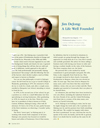
Attorney Jim DeJong was featured in an article appearing in the 2013 Summer Edition of the Marquette Lawyer Magazine. Read the article about Jim here.
Effective January 1, 2013, pursuant to the Patient Protection and Affordable Care Act, 26 U.S.C. § 1411 imposes a 3.8% Net Investment Income Tax on individuals, estates and trusts which have “Net Investment Income” and modified adjusted gross income above specified statutory threshold amounts. For individuals, the tax is imposed on the lesser of: (A) the Net Investment Income for the taxable year, or (B) the excess of modified adjusted gross income for the taxable year over the threshold amount ($250,000 for married individuals filing jointly; $125,000 for married individuals filing separately; $200,000 for single individuals). For estates and trusts which are subject to the tax, the tax is imposed on the lesser of: (A) the undistributed Net Investment Income for the taxable year, or (B) the adjusted gross income for the taxable year over the dollar amount at which the highest tax bracket for an estate or trust begins for the taxable year.
For purposes of the tax, “Net Investment Income” is defined as the sum of the following, less any applicable deductions:
Applicable deductions may include expenses related to investment interest, advisory and brokerage fees, rental and royalty income, and state and local income taxes which are allocable to items included in Net Investment Income.
Net Investment Income specifically does not include such items as wages, unemployment compensation, operating income from non-passive business activities, social security benefits, alimony, tax exempt interest, self-employment income, Alaska Permanent Fund Dividends, and distributions from certain qualified retirement plans. However, these items may be subject to the .9% Additional Medicare Tax.
The following paragraphs highlight a few of the rules specific to particular types of income which may or may not be subject to the tax. The information provided herein is not intended to address all sources of income subject to the tax, or provide an exhaustive summary of the applicable rules.
S-Corporations. Generally, an interest in a pass-through entity such as an S Corporation is not property held in a trade or business, so that any gain or loss from the sale of such interest would be Net Investment Income. However, the IRS has limited the amount of gain or loss from the disposition from an interest in an S Corporation to the net gain or loss that would result if the S Corporation sold all of its assets at fair market value immediately before the disposition of the interest.
Working Capital. Any income, gain or loss attributable to capital set aside for the future needs of a trade or business is Net Investment Income.
Child’s Interest. Any amount included on a parent’s Form 1040 as a result of filing Form 8814 for Parent’s Election to Report Child’s Interest and Dividends is included in calculating Net Investment Income, but does not include any amount excluded on Form 1040 due to threshold requirements.
Pension and Deferred Compensation Distributions. While Net Investment Income does not include distributions from certain qualified employee benefit plans, such distributions are included in determining the threshold amounts if they are included in the taxpayer’s gross income.
The rules regarding the Net Investment Income Tax are complex and continue to evolve as final regulations are determined. In making a determination of how you may be impacted by the tax, it is important to contact a professional who may advise you as to the application of specific rules to your particular situation.
If you have any questions regarding this article, please contact Attorney Megan Harried at O’Neil Cannon at 414-276-5000.
The Milwaukee Justice Center, organized by Milwaukee County, Milwaukee Bar Association, and Marquette University School of Law provides legal assistance to individuals who cannot afford legal representation. In 2012, the volunteers of the Center served nearly 9,000 hours of pro bono service to 10,659 unrepresented civil litigants.
Sixteen attorneys from the law firm of O’Neil, Cannon, Hollman, DeJong and Laing contributed to the success of the Milwaukee Justice Center to include:
Grant Killoran has been elected to serve on the Board of Directors of the Milwaukee Debate League.
The Milwaukee Debate League works in partnership with Milwaukee-area high schools to support academic debate teams. Created in 2007, the Milwaukee Debate League provides unique youth development programming targeting high school students, blending competition and rigorous work in academic high school debate with fun. Through this spirited competition, students have the opportunity to become articulate and informed leaders in their schools and effective advocates for themselves, their families and their community. For more information on the Milwaukee Debate League, visit www.debatemilwaukee.org.
Grant Killoran is the Chair of the Litigation Practice Group at O’Neil, Cannon, Hollman, DeJong and Laing. He previously was involved with academic debate at both the high school and collegiate levels, both as a debater and debate coach. He continues to benefit in his legal practice from the skills gained during his involvement with academic debate and is honored to serve on the Board of the Milwaukee Debate League.
Grant Killoran has significant and diverse trial experience representing clients in Wisconsin State and Federal Courts, and courts around the country, focusing on complex business and health care disputes. Mr. Killoran devotes a portion of his practice to arts and entertainment law, with an emphasis on the music and film industries. He is a Fellow with the American Bar Foundation, has served as one of the State Bar of Wisconsin’s five Delegates to the American Bar Association’s House Delegates and is a Co-Editor of the ABA Section of Litigation’s Health Law Litigation Newsletter.
Wisconsin is a marital property state, and the applicable laws are set forth in the Marital Property Act (the “Act”), codified in Chapter 766 of the Wisconsin Statutes. The Act determines the property rights of married spouses during life and at death. The Act applies to a married couple after their “determination date,” which is the date on which the last of the following requirements is met: (i) marriage; (ii) both spouses are domiciled in Wisconsin; and (iii) 12:01 a.m. on January 1, 1986.
Under the provisions of the Act, marriages are generally considered equal partnerships, and after the determination date married spouses are treated as sharing equally in most assets acquired by either spouse during the marriage. Such assets, which include property acquired from the earnings of either spouse, are presumed to be marital property. In effect, each spouse is presumed to own an undivided one-half interest in each item of marital property acquired during the marriage, regardless of how the property is titled. On the other hand, property acquired by a spouse prior to the determination date, and property acquired by a spouse during marriage by gift or inheritance from a third party, is presumptively classified as the individual property of the acquiring spouse. The non-acquiring spouse does not have ownership rights in the acquiring spouse’s individual property during life or at death.
Importantly, the Act sets forth the “default” rules, but a married couple may enter into a marital property agreement to alter any of the provisions of the Act, including the classification of any or all assets as marital or individual property. There are many benefits to entering into such an agreement, especially because determining with exactitude the property classification of an item of property under the Act is at best an uncertain process. A marital property agreement provides certainty as to the classification of property, which is especially important when the couple has created a comprehensive and tax-conscious estate plan for the disposition of their assets at death.
In Wisconsin, it is common for a married couple to enter into a marital property agreement classifying all property of both spouses as marital property, including property which would otherwise be classified as the individual property of one spouse. These “opt-in” agreements are especially suitable for a first marriage where neither spouse has children from a prior relationship. Classifying all property as marital property simplifies estate administration because it is no longer necessary for the couple to keep marital and individual property separate, and because it will not be necessary to analyze which assets are marital property and which are individual property upon the death of a spouse. Additionally, there are ordinarily significant income tax advantages to opt-in marital property agreements. Classifying all of a married couple’s assets as marital property as part of a comprehensive estate plan equalizes each spouse’s estate, and will usually enable the couple to maximize the estate tax exemptions available for each spouse. Further, at the time of death, the basis of assets passing from a decedent for purposes of determining gain or loss for income tax purposes is “stepped-up” (or “down”) to an amount equal to a fair market value of the assets as of the date of death. In the case of marital property, the basis of a surviving spouse’s marital property interest is also stepped-up. “Opt-in” marital property agreements often also contain what is known as a “Washington Will” provision, which states that upon the death of either spouse, all or any of the property of one or both spouses passes to a designated person, trust or other entity by nontestamentary disposition, and without probate. As such, the provision is a simple mechanism whereby the spouses contract for the disposition of all or a portion of their community property at the time of each of their deaths, and simultaneously avoid probate as to that property.
Alternatively, a married couple may choose to enter into a marital property agreement reclassifying all property of both spouses as the individual property of each spouse, including property which would otherwise be classified as marital property. In these “opt-out” agreements, the wages earned by each spouse, and all property acquired with the earnings, will be classified as the individual property of the earning spouse. The non-earning spouse will not have any ownership rights in such assets, either in life or at death. An “opt-out” marital property agreement may be advantageous in second marriage situations, where one or both spouses have children from a prior relationship, because the agreement will allow each spouse to bequeath his or her individual property to his or her own children at death.
Marital property agreements may also reclassify only certain assets. For example, a spouse may want to bequest a specific asset to a person other than his or her spouse at death. A marital property agreement could classify only the specific asset as the individual property of the spouse. As a result, the spouse would have full ownership rights in the asset during life, and the right to bequeath the entire asset to the third party at death. Without such an agreement, the spouse would only have the right to bequeath his or her one-half interest in the asset.
Marital property agreements are essential tools for creating a comprehensive estate plan tailored to the individual needs of the couple, and have a significant impact on the disposition of a couple’s assets both during life and at death.
If you have any questions regarding this article, please contact Attorney Megan Harried at O’Neil Cannon at 414-276-5000.
In a durable power of attorney, the principal appoints someone to oversee his financial affairs, including in the event he becomes incompetent as a result of injury or illness. A broad durable power of attorney may authorize the agent to take any action as fully and effectually in all respects as the principal could do if personally present. However, even the most broadly stated power of attorney does not authorize the agent to make gifts on behalf of the principal unless the power of attorney expressly grants the agent such power. The law requires that gifting powers be expressly stated in the durable power of attorney in order to reduce the risk that the agent will engage in financial abuse of the principal.
Gifts are an important estate planning tool, as making gifts during life often results in significant tax savings at the principal’s death. Therefore, it is advantageous for an agent under a durable power of attorney to be authorized to make gifts for estate planning purposes. Generally, it is best if the scope of an agent’s power to make gifts on behalf of the principal is limited, so as to reduce the potential for abuse.
If the durable power of attorney states in general language that the agent is authorized to make gifts, without express limitations, by law the agent is authorized to make a gift up to the amount of the annual federal gift tax exclusion, or twice that amount if the principal’s spouse consents to a split gift, as defined by the tax code. Further, such general language authorizes the agent to make a gift of the principal’s property if the agent determines doing so is consistent with the principal’s objectives, if known, or if unknown, with the principal’s best interest, based on all applicable factors, including: (i) the value and nature of the principal’s property; (ii) the foreseeable obligations and need for maintenance of the principal; (iii) the minimization of all taxes; (iv) the principal’s eligibility for any benefit, program or assistance; and (v) the principal’s personal history of making such gifts.
A durable power of attorney may expressly provide that the agent is only authorized to make gifts to specified classes of persons, such as the principal’s descendants. Such a provision may be advisable if the agent is someone other than the principal’s spouse or family member, in order to reduce the risk that the agent will make gifts to himself or third parties he wishes to benefit, contrary to the principal’s desires or best interest.
A durable power of attorney may also expressly require that the agent make gifts only in a manner which continues the principal’s previously established pattern of gift-making for estate planning purposes. Such a provision helps ensure that the agent will make gifts which align with the principal’s desires and objectives.
Further, a durable power of attorney may expressly provide that the aggregate of all gifts to any one recipient in any one year shall not exceed the amount of the annual federal gift tax exclusion. Such a provision provides the agent with the flexibility to maximize tax-free annual gifts for estate planning purposes, and reduces the risk that the agent will deplete the principal’s estate.
It is also possible for the principal to expressly authorize the agent to make any gifts that the agent believes will benefit the principal or the principal’s estate, including gifts to the agent himself. Such a provision grants the agent the broadest authority to make gifts on behalf of the principal, but it also provides the greatest potential for abuse. Therefore, it is crucial that a principal granting such broad authority trust the agent unconditionally.
In drafting a durable power of attorney as part of a comprehensive estate plan, it is important to consider what gifting powers should be granted in light of the principal’s personal and financial situation. While gifting powers are useful for estate planning purposes, it is also important to limit gifts to those the principal might have made, and minimize the risk for financial abuse.
If you have any questions regarding this article, please contact Attorney Megan Harried at O’Neil Cannon at 414-276-5000.
Attorney Blair recently joined the firm’s Banking and Creditors’ Rights Group. She will assist secured and unsecured corporate or individual creditors and other entities with the work out of commercial loans, leases, and other obligations. Ms. Blair, formerly a law clerk to the Honorable Susan V. Kelley, U.S. Bankruptcy Court of the Eastern District of Wisconsin, and a shareholder at Kravit, Hovel and Krawczyk, S.C., also represents receivers in state Chapter 128 Receivership proceedings, real estate foreclosures, the wind-up of corporations, collection matters, and with the acquisition or disposition of business assets. She is a graduate of Marquette University Law School, J.D., magna cum laude.
O’Neil Cannon, founded in Milwaukee in 1973, is a full-service legal practice that primarily focuses on providing business law and civil litigation services to closely-held businesses and their owners. The firm represents corporations, institutions and partnerships at all stages of the business life cycle, helping them start, grow and transition from one generation to the next. We also assist business owners with their personal legal needs including tax and estate planning, family law and litigation—including personal injury litigation.
O’Neil, Cannon, Hollman, DeJong and Laing S.C. is proud to announce that the following nine attorneys were selected for inclusion on the Super Lawyers list, which is limited to 5% of all Wisconsin attorneys, as published in the December 2012 edition of Milwaukee Magazine:
The Firm is proud to additionally announce that the following six attorneys were selected for inclusion on the Super Lawyers “Rising Stars” list, which “recognize[s] the top up-and-coming attorneys in the state—those who are 40 years old or younger, or who have been practicing for 10 years or less:”
The Firm is proud to further announce that Dean Laing was selected by Super Lawyers as one of the “Top 10 Attorneys” in Wisconsin, regardless of practice area. Of the over 15,000 attorneys in Wisconsin, Dean was the only commercial litigator selected to the list. He was also selected by Super Lawyers as one of the “Top 25 Attorneys in the Milwaukee Area.”
Super Lawyers is a national rating service which rates attorneys in all 50 states. The selection process is multi-phased and includes independent research, peer nominations and peer evaluations. As part of its process, Super Lawyers surveyed more than 15,000 attorneys and judges in Wisconsin, looking for the best attorneys in the State.
The New Jersey Supreme Court recently upheld the findings of a Special Master who made the following determinations about Super Lawyers:
“[T]he selection procedures employed by [Super Lawyers] are very sophisticated, comprehensive and complex.
It is absolutely clear… that [Super Lawyers does] not permit a lawyer to buy one’s way onto the list, nor is there any requirement for the purchase of any product for inclusion in the lists or any quid pro quo of any kind or nature associated with the evaluation and listing of an attorney or in the subsequent advertising of one’s inclusion in the lists.”
O’Neil Cannon is pleased to announce that Attorney Douglas P. Dehler has been elected a shareholder of the Firm. Mr. Dehler’s legal practice involves business litigation, class action litigation, whistleblower (qui tam) lawsuits, ERISA fiduciary litigation, and the representation of clients in a wide range of insurance matters, including insurance bad faith litigation. He is a University of Wisconsin Law School graduate, and a member of the pro bono committee for the Eastern District of Wisconsin Bar.
O’Neil Cannon, founded in Milwaukee in 1973, is a full-service legal practice that primarily focuses on providing business law and civil litigation services to closely-held businesses and their owners. The firm represents corporations, institutions and partnerships at all stages of the business life cycle, helping them start, grow and transition from one generation to the next. We also assist business owners with their personal legal needs including tax and estate planning, family law and litigation—including personal injury litigation.
On December 6th 2012, Chad Richter received the 2012 Outstanding Leadership Award from MBBI. The award was presented at MBBI’s annual Private Equity Connection held at the Milwaukee Athletic Club, which included over 20 different Private Equity firms and approximately 150 attendees.
MBBI is one of the largest organizations of M&A advisors and professionals in the Midwest, and is comprised of brokers, intermediaries, investment bankers, attorneys, accountants, commercial bankers, individual buyers, and private equity groups, all assisting businesses on transactions with a value in the $1M-$30M range.