Congress Debates Limiting Estate Planning Technique: Now Is a Good Time to Consider a GRAT

The grantor retained annuity trust (GRAT) has been a staple vehicle for estate planning since it was first introduced twenty years ago by the Revenue Reconciliation Act of 1990. A GRAT can effectively transfer property from a grantor to a beneficiary, while greatly reducing the amount of tax the grantor would otherwise owe on the gift, if the gift was transferred without a GRAT.

A GRAT is created by transferring property to a trust for a fixed number of years. During the life of the trust, the grantor is paid an annual annuity from that trust. Upon the expiration of the trust, any remaining property in that trust passes to the beneficiary. Tax savings are realized by placing property expected to greatly increase in value into the trust. Tax is then assessed by adding the value of the initial property plus a statutorily fixed interest rate based on the month the trust was created as found in Code Sec. 7520. The current fixed interest rate for August 2010 is 2.6%, according to Rev. Rul. 2010-19. Therefore, as long as the annuity payments over the fixed period of the trust equal the initial property value plus the fixed interest rate, there would be no gift tax assessed on any remaining property left in the trust upon expiration, which would be automatically transferred to the beneficiary.

In other words, if a GRAT is created this month with any type of property expected to appreciate more than 2.6% over the life of the trust, any profits greater than 2.6% would be considered a tax free gift by the IRS to the beneficiary without requiring the donor to utilize a portion of the standard $1,000,000 lifetime gift tax exemption. Currently, the minimum term of a GRAT is two years and there are no restrictions on the structure of annuity payments, effectively allowing a donor to have little to no tax burden if properly created.

Recently Congress has been considering limiting the effectiveness of GRATs. President Obama’s 2010 budget proposal and 2011 revenue suggestions sought to change the minimum term of a GRAT from two to ten years. Additionally, the House attempted to attach a similar curtailment of GRAT to a small business jobs bill and a supplemental spending bill. The Senate’s version of the small business jobs bill did not contain the GRATs provision, and ultimately the House was unsuccessful is attaching the provision to the supplemental spending bill. However, the Senate currently has a GRAT curtailment provision in a proposed COBRA extension act, S. 3548, to provide funding for the bill, an increasingly common trend for proposed anti-GRAT legislation.

The current Senate bill proposes to (1) raise the minimum GRAT term to ten years, (2) require the remaining interest, as calculated at the time of GRAT creation, to be greater than zero, and (3) prohibit the annuity payments from decreasing in value from the first year until after the initial ten years of the trust. These proposed changes have the potential to significantly alter GRATs as we know it. By raising the minimum term to ten years, a grantor increases the chances that he or she may pass away prior to the GRAT expiring. A GRAT that is ongoing at the time of the grantors death reverts back to the estate of the grantor, along with any appreciation, and does not transfer to the beneficiary. In this scenario, not only does the beneficiary get nothing, but the property is now taxable to the grantor’s estate. Furthermore, by disallowing decreased payments, the proposed bill shuts the door on scheduling high initial payments to reduce the amount of the trust that reverts back to the estate. Lastly, the bill creates great uncertainty about exactly how much “greater than zero” the gift must be, meaning that there will likely be disagreements between the IRS and GRAT creators until initial revenue rulings are proposed.

Currently, GRATs are functioning without any of the proposed limitations. However, as the above government actions indicate, that is likely to soon change. Therefore, if you have property that is likely to appreciate more than 2.6% over at least the next two years, and you wish to avoid using part or all of your lifetime $1,000,000 gift tax exemption to transfer that property, now is the time to create and fund a GRAT. Any GRAT created and funded prior to the enactment of any legislation, similar to what is described above, will be grandfathered in to the old GRAT tax laws and you will still receive the significant tax benefits that GRATs currently provide. However, if you wait too long, it is likely that you will miss out on fully capitalizing on one of the best intergenerational wealth preservation techniques currently available.

The Best Lawyers in America®

The following O’Neil Cannon attorneys were selected for inclusion in the 17th edition of The Best Lawyers in America 2011 in the following practice areas:

  • James G. DeJong—Corporate Law
  • Seth E. Dizard—Bankruptcy and Creditor-Debtor Rights Law
  • John G. Gehringer—Construction Law, and Real Estate Law
  • Dennis W. Hollman—Real Estate Law
  • Dean P. Laing—Personal Injury Litigation, and Product Liability Litigation
  • Thomas A. Merkle—Family Law

The Best Lawyers in America “is the oldest and most respected peer-review publication in the legal profession,” and is based on more than 3.1 million detailed evaluations of lawyers by other lawyers.” Lawyers “are not required or allowed to pay a fee to be included in The Best Lawyers in America,” and “have no say in deciding which practice areas they are included in;” they are selected for inclusion in the publication, and assigned practice areas, based entirely on the votes they receive from their peers.

Given that less than 3% of all attorneys in the U.S. are included in The Best Lawyers in America, it is a true honor for O’Neil Cannon to have approximately 25% of its attorneys selected for inclusion in this highly-respected publication.


Seventh Circuit: Title VII Trumps Patient and Customer Racial Preferences

A recent Seventh Circuit Court of Appeals ruling makes clear that an employer’s obligation under Title VII of the Civil Rights Act of 1964 to provide employees with a discrimination-free workplace takes precedence over patient or customer preferences regarding the race of employees from whom they receive services. The court held, in Chaney v. Plainfield Health Center, that by accommodating a patient’s demand for white-only health-care providers, a nursing home maintained a racially hostile work environment in violation of Title VII. (The court also determined that issues of fact existed as to whether the defendant nursing home’s discharge of the plaintiff, a black nursing assistant, was motivated by race).

In Chaney, the defendant nursing home had a policy of honoring the racial preferences of its residents when assigning them health-care providers in order to avoid violating federal and state laws the nursing home viewed as requiring it to grant residents certain related rights to privacy, bodily autonomy and choice of providers. The court noted that, while allowing patients to choose the gender of their health care providers is permissible under Title VII, the patient-privacy grounds justifying employee assignment based on gender-based preferences are inapplicable to race-based preferences. The court further dismissed arguments that state or federal health laws otherwise permitted a policy of permitting patients to choose providers on racial bases, reasoning that laws requiring access to chosen providers did not necessitate race-based work practices and any state law otherwise conflicting with Title VII would be preempted.

The court also rejected the defendant’s contention that, as a practical matter, its race-based policy protected black employees from racial harassment from the residents, referencing several alternative means to accomplish such objectives. Calling the defendant’s willingness to accede to a patient’s racial preferences “the principal source of the racial hostility in the workplace” where the plaintiff allegedly experienced three specific incidents of racial harassment from co-workers, the court reasoned that barring such a policy was consistent with judicial precedence, which “now widely accept[s] that a company’s desire to cater to the perceived racial preferences of its customers is not a defense under Title VII for treating employees differently based on race.” The court concluded that the defendant nursing home’s status as a medical provider and permanent home to its residents did not exempt it from Title VII’s prohibitions of such race-based employment policies.

A full copy of the decision can be found here.


Texas Billionaire’s Death Triggers Renewed Estate Tax Debate

For the first time in nearly 100 years, extremely wealthy individuals who pass away this year will leave enormous estates to friends and family tax-free. Since 1916, the estates of America’s wealthiest individuals have been subject to a federal estate tax. Over the years the minimum value has fluctuated, but the tax has remained in effect. In 2009, for example, the tax applied to the portion of individual estates valued over $3.5 million, or the portion of a couple’s estate valued over $7 million. However, because of a law passed by Congress in 2001, the estate tax has been entirely repealed for the year 2010.

In March of this year the first American since 1916 was able to pass a multi-billion dollar estate to his children and grandchildren without paying an estate tax. Dan L. Duncan, a Texas pipeline tycoon ranked 74th wealthiest individual in the world, passed away from a brain hemorrhage in late March, leaving billions of dollars in assets behind. Had Duncan passed away in 2009, his $9 billion estate would have been subject to at least a 45% federal estate tax.

Supporters of the estate tax argue that it is unconscionable to allow the wealthiest Americans a tax break at a time when income gaps between the wealthy and poor are so large and deficits so high. Opponents of the estate tax, however, argue that taxing an individual when income is earned and then again at death is unfair and it forces the liquidation of family owned businesses and farms. Read the full New York Times article for a more detailed look at the Duncan estate and the implications of the estate tax repeal.

This window of opportunity for tax savings may be short lived as the current law has the estate tax returning in 2011 with an exemption of only $1 million for individuals and a top marginal rate of 55%.


Attorneys Randy Nash and Jason Scoby Publish Article in ABA’s Health Law Litigation Newsletter

Randy Nash and Jason Scoby recently published an article in the Spring/Summer 2010 edition of the American Bar Association’s Health Law Litigation newsletter entitled “New Rules Dramatically Affect Health Care Expert Witness Disclosures.”

The article discusses the existing Federal Rules of Civil Procedure and a proposed change to Rule 26 involving the disclosure of expert witness draft reports and communications between the attorney and an expert witness in a case. This proposed rule change has the potential to impact expert witness disclosures before the federal courts. It is expected to go into effect on December 1, 2010.

Under the current rule, an expert witness’s entire file with regard to the matter in litigation, including any drafts of the expert’s report and any communications with the attorney, is discoverable by the opponent in the lawsuit.

The Committee on Rules of Practice and Procedure has recommended that the current rule be amended, stating that the rule has caused “significant practical problems.” The Committee described the problem as follows:

Lawyers and experts take elaborate steps to avoid creating any discoverable record and at the same time take elaborate steps to attempt to discover the other side’s drafts and communications. The artificial and wasteful discovery-avoidance practices include lawyers hiring two sets of experts—one for consultation, to do the work and develop the opinions, and one to provide the testimony—to avoid creating a discoverable record of the collaborative interaction with the experts. The practices also include tortuous steps to avoid having an expert take any notes, make any record of preliminary analyses or opinions, or produce any draft report. Instead, the only record is a single, final report.

Recognizing these issues, many have sought to change the discovery rules. The proposed amendment to Rule 26 attempts to avoid disclosure of experts’ draft reports and attorney/expert communications. The goal is to permit the attorney to communicate freely with the expert about the attorney’s thoughts and opinions relating to the case without fear of those communications being discovered by opposing counsel. The Rule also aims to avoid the unnecessary costs caused by hiring multiple experts and to prevent attorneys from taking other intricate maneuvers to evade the discovery of communications or drafts of expert opinions.

The Supreme Court recently approved these amendments to Rule 26 of the Federal Rules of Civil Procedure. It is expected that Congress will approve the amended Rule, and if it does, the amended Rule 26 will go into effect on December 1, 2010. A full copy of “New Rules Dramatically Affect Health Care Expert Witness Disclosures” can be found here.


O’Neil, Cannon, Hollman, DeJong and Laing Elect Joseph Gumina as Shareholder

O’Neil Cannon is pleased to announce that Attorney Joseph E. Gumina has recently been elected as a shareholder of the firm. Joe will continue his labor and employment practice representing management in the states of Illinois and Wisconsin, and will represent clients in litigation matters in both state and federal courts, including the federal district courts in Illinois, Indiana, and Wisconsin.

O’Neil Cannon, founded in Milwaukee in 1973, is a full-service legal practice that primarily focuses on providing business law and civil litigation services to closely-held businesses and their owners. The firm represents corporations, institutions and partnerships at all stages of the business life cycle, helping them start, grow and transition from one generation to the next. We also assist business owners with their personal legal needs including tax and estate planning, family law and litigation – including personal injury litigation.


Attorney Mager Elected to the State Bar of Wisconsin Family Law Section’s Board of Directors

Attorney Gregory S. Mager has been selected to serve on the State Bar of Wisconsin Family Law Section’s Board of Directors from July 2010 to July 2013.

Attorney Mager is a shareholder with O’Neil Cannon, where he concentrates his practice on family law. He has served as Editor in Chief of the Wisconsin Journal of Family Law, and as chair and vice-chair of various committees of the American Bar Association’s Family Law Section. He is a member of the Collaborative Family Law Council of Wisconsin, Inc. and the Divorce Cooperation Institute. Attorney Mager received his B.A., M.A., and J.D. from Marquette University.

O’Neil Cannon, founded in Milwaukee in 1973, is a full-service legal practice that primarily focuses on providing business law and civil litigation services to closely-held businesses and their owners. The firm represents corporations, institutions and partnerships at all stages of the business life cycle, helping them start, grow and transition from one generation to the next. We also assist business owners with their personal legal needs including tax and estate planning, family law and litigation – including personal injury litigation.


Will Contests

In Wisconsin, any person of sound mind who is at least eighteen years old is presumed capable of making a will. A will should be created voluntarily and express how the testator desires his or her property to be distributed upon death. However, when another person’s influence over the testator becomes so strong it overpowers the testator’s free will, such influence is “undue,” and the resulting will may be invalid.

As the baby boomer generation ages, many people forecast an increase in challenges to wills or trusts based on undue influence. Generally, these legal challenges are brought when elderly or ill people make or change wills or trusts which are inconsistent with that person’s character, and often involve generous bequests to non-family members. The unnatural beneficiary is often someone who holds a position of power and influence over the testator.

Under Wisconsin law, undue influence can be shown in two ways. The first way to show undue influence is by proving four things. First, it must be proved that the testator is susceptible to undue influence. Factors include the testator’s age, personality, physical and mental health, and his or her ability to handle business affairs. Second, it must be proved that the other person had the opportunity to exercise such influence and effect the wrongful purpose. Third, it must be proved that the other person had a disposition to influence unduly in order to gain an improper favor. This implies willingness to do something wrong or unfair, such as overreaching or taking advantage of the testator, not just a desire to benefit from the estate. Finally, it must be proved that a result occurred that was clearly the effect of the supposed influence. The fact that the other person benefits from a will does not prove undue influence. Instead, this requirement is met when a person benefits from a will against natural expectations under the circumstances.

The second test for proving undue influence has two requirements: (1) a confidential or fiduciary relationship between the testator and the favored beneficiary; and (2) suspicious circumstances surrounding the making of the will. However, a will is not set aside based on someone’s suspicion alone.

Other states have established similar elements to prove a claim of undue influence. Undue influence challenges to wills or trusts can be difficult to prove because they depend almost entirely on the particular facts and circumstances in an individual case. These facts often must be proved by indirect evidence because often one who is attempting to unduly influence a testator acts subtly and in secret.


Attorney Laing in the News

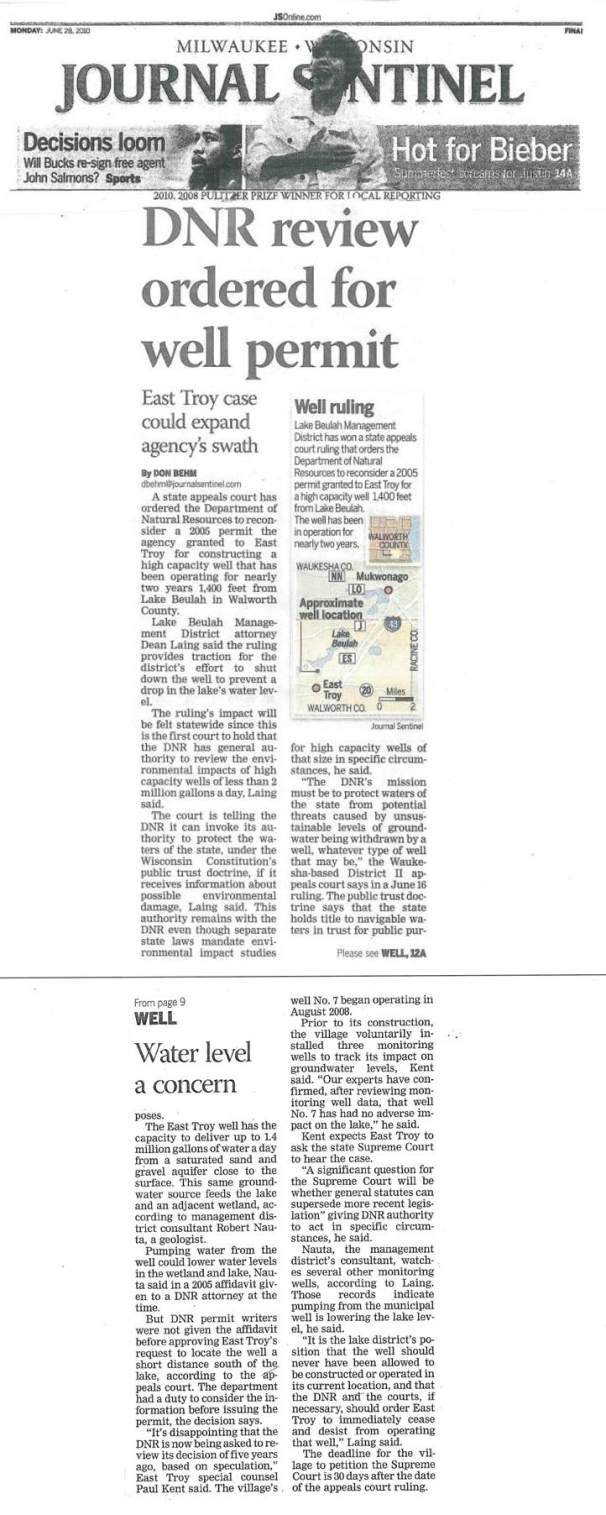
The below article, discussing a decision of the Wisconsin Court of Appeals in a case being handled by Attorney Dean Laing of our firm, was published in the June 28, 2010 edition of the Milwaukee Journal Sentinel. Our client, Lake Beulah Management District, was successful in the appeal.


Firm Obtains Favorable Decision from Wisconsin Court of Appeals

On June 16, 2010 the Wisconsin Court of Appeals issued a significant decision in a case of first impression being handled by our firm. The case has a long history. In 2005, the Wisconsin Department of Natural Resources (the “DNR”) issued a permit to the Village of East Troy (the “Village”) authorizing the Village to construct and operate a high capacity well approximately 1,400 feet from the shores of Lake Beulah, an 834-acre lake located in Walworth County, Wisconsin, with the capacity to withdraw 1,400,000 gallons of groundwater per day (“gpd”). The Village requested approval to construct and operate the well purportedly to eliminate current deficiencies and supplement for future growth.

The Lake Beulah Management District (the “District”), which consists mostly of residents owning frontage on the lake, objected to the issuance of the permit, contending that the proposed well would negatively impact the waters of the lake. The District contended that the DNR has a duty under the Public Trust Doctrine to determine whether a high capacity well, regardless of capacity, will negatively impact the waters of the State before issuing a permit to construct and operate such a well, and the DNR made no such determination in connection with the Village’s permit application. The Public Trust Doctrine is a long-standing legal doctrine which requires the State to steadfastly preserve the State’s waters for fishing, hunting, recreation and scenic beauty.

In 2006 the District filed a lawsuit in the circuit court challenging the issuance of the permit. In the lawsuit, the Village argued that the DNR has no authority to consider whether a high capacity well, with withdrawal capacity of less than 2 million gpd, will negatively impact the waters of the State in considering an application for such a well, because sections 281.34 and 281.35, Wis. Stats., only grant the DNR that authority for wells with withdrawal capacities of more than 2 million gpd. The DNR took a contrary position, arguing that while it has the authority to consider that issue for wells with withdrawal capacities of less than 2 million gpd, it had no duty to do so with respect to the Village’s permit application because no scientific evidence was presented to it indicating that the proposed well would negatively impact the waters of Lake Beulah. The District countered by arguing that not only did the DNR have the authority to consider whether the proposed well will negatively impact the waters of Lake Beulah, it had the duty to do so because the DNR had an affidavit of a licensed geologist, prior to issuing the permit, indicating that the well “would cause adverse environmental impacts to the wetland and navigable surface waters of Lake Beulah.”

The Wisconsin Court of Appeals agreed with the District. Initially, the court rejected the Village’s argument that the DNR has no authority to consider whether high capacity wells with withdrawal capacities of less than 2 million gpd will negatively impact the waters of the State before issuing a permit for construction and operation of such a well, holding that “[t]he permit process has to be, as a matter of common sense, more than a mechanical, rubber-stamp transaction,” and “[t]he DNR’s mission must be to protect waters of the state from potential threats caused by unsustainable levels of groundwater being withdrawn by a well, whatever type of well that may be.” (emphasis added)

The Court of Appeals further held that the geologist’s affidavit was “certainly” sufficient to warrant “further, independent investigation,” and remanded the case to the DNR to reconsider the Village’s permit application in light of that affidavit.

The Court of Appeals’ 25-page decision, issued by a unanimous 3-judge panel, will have far reaching impact on municipalities requesting high capacity well permits from the DNR, as the DNR must now consider the Public Trust Doctrine in connection with every application for such a permit, regardless of the well’s capacity, whenever there is information suggesting that the proposed well may negatively impact the waters of the State.

The District was represented by Dean P. Laing of our firm in this case. A copy of the Court of Appeals’ decision can be found here.