Attorney Mager Elected to the State Bar of Wisconsin Family Law Section’s Board of Directors

Attorney Gregory S. Mager has been selected to serve on the State Bar of Wisconsin Family Law Section’s Board of Directors from July 2010 to July 2013.

Attorney Mager is a shareholder with O’Neil Cannon, where he concentrates his practice on family law. He has served as Editor in Chief of the Wisconsin Journal of Family Law, and as chair and vice-chair of various committees of the American Bar Association’s Family Law Section. He is a member of the Collaborative Family Law Council of Wisconsin, Inc. and the Divorce Cooperation Institute. Attorney Mager received his B.A., M.A., and J.D. from Marquette University.

O’Neil Cannon, founded in Milwaukee in 1973, is a full-service legal practice that primarily focuses on providing business law and civil litigation services to closely-held businesses and their owners. The firm represents corporations, institutions and partnerships at all stages of the business life cycle, helping them start, grow and transition from one generation to the next. We also assist business owners with their personal legal needs including tax and estate planning, family law and litigation – including personal injury litigation.


Attorney Laing in the News

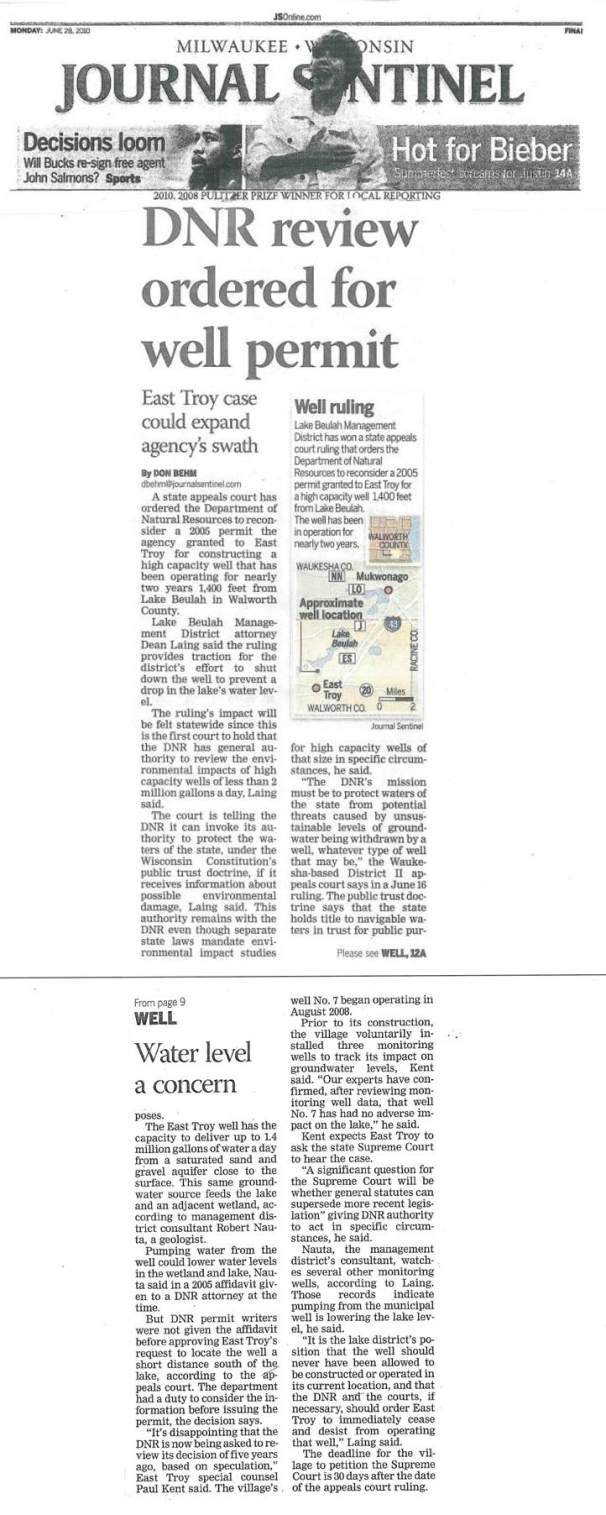
The below article, discussing a decision of the Wisconsin Court of Appeals in a case being handled by Attorney Dean Laing of our firm, was published in the June 28, 2010 edition of the Milwaukee Journal Sentinel. Our client, Lake Beulah Management District, was successful in the appeal.


Firm Obtains Favorable Decision from Wisconsin Court of Appeals

On June 16, 2010 the Wisconsin Court of Appeals issued a significant decision in a case of first impression being handled by our firm. The case has a long history. In 2005, the Wisconsin Department of Natural Resources (the “DNR”) issued a permit to the Village of East Troy (the “Village”) authorizing the Village to construct and operate a high capacity well approximately 1,400 feet from the shores of Lake Beulah, an 834-acre lake located in Walworth County, Wisconsin, with the capacity to withdraw 1,400,000 gallons of groundwater per day (“gpd”). The Village requested approval to construct and operate the well purportedly to eliminate current deficiencies and supplement for future growth.

The Lake Beulah Management District (the “District”), which consists mostly of residents owning frontage on the lake, objected to the issuance of the permit, contending that the proposed well would negatively impact the waters of the lake. The District contended that the DNR has a duty under the Public Trust Doctrine to determine whether a high capacity well, regardless of capacity, will negatively impact the waters of the State before issuing a permit to construct and operate such a well, and the DNR made no such determination in connection with the Village’s permit application. The Public Trust Doctrine is a long-standing legal doctrine which requires the State to steadfastly preserve the State’s waters for fishing, hunting, recreation and scenic beauty.

In 2006 the District filed a lawsuit in the circuit court challenging the issuance of the permit. In the lawsuit, the Village argued that the DNR has no authority to consider whether a high capacity well, with withdrawal capacity of less than 2 million gpd, will negatively impact the waters of the State in considering an application for such a well, because sections 281.34 and 281.35, Wis. Stats., only grant the DNR that authority for wells with withdrawal capacities of more than 2 million gpd. The DNR took a contrary position, arguing that while it has the authority to consider that issue for wells with withdrawal capacities of less than 2 million gpd, it had no duty to do so with respect to the Village’s permit application because no scientific evidence was presented to it indicating that the proposed well would negatively impact the waters of Lake Beulah. The District countered by arguing that not only did the DNR have the authority to consider whether the proposed well will negatively impact the waters of Lake Beulah, it had the duty to do so because the DNR had an affidavit of a licensed geologist, prior to issuing the permit, indicating that the well “would cause adverse environmental impacts to the wetland and navigable surface waters of Lake Beulah.”

The Wisconsin Court of Appeals agreed with the District. Initially, the court rejected the Village’s argument that the DNR has no authority to consider whether high capacity wells with withdrawal capacities of less than 2 million gpd will negatively impact the waters of the State before issuing a permit for construction and operation of such a well, holding that “[t]he permit process has to be, as a matter of common sense, more than a mechanical, rubber-stamp transaction,” and “[t]he DNR’s mission must be to protect waters of the state from potential threats caused by unsustainable levels of groundwater being withdrawn by a well, whatever type of well that may be.” (emphasis added)

The Court of Appeals further held that the geologist’s affidavit was “certainly” sufficient to warrant “further, independent investigation,” and remanded the case to the DNR to reconsider the Village’s permit application in light of that affidavit.

The Court of Appeals’ 25-page decision, issued by a unanimous 3-judge panel, will have far reaching impact on municipalities requesting high capacity well permits from the DNR, as the DNR must now consider the Public Trust Doctrine in connection with every application for such a permit, regardless of the well’s capacity, whenever there is information suggesting that the proposed well may negatively impact the waters of the State.

The District was represented by Dean P. Laing of our firm in this case. A copy of the Court of Appeals’ decision can be found here.

Firm Successfully Defends Class Action Lawsuit

Effective July 1, 2005, the Wisconsin law requires all mortgage brokers to use mortgage broker agreements and consumer disclosure statements in a form prescribed by the Wisconsin Department of Financial Institutions (“WDFI”) with their consumer clients. See Wis. Stat. § 224.79. The WDFI has stated that “no change to the wording of either form is acceptable or approved.” McGlone Mortgage Company, Inc. (“McGlone”), a Wisconsin licensed mortgage broker, did not begin using the WDFI prescribed forms until July 2008.

On February 20, 2009 John J. Avudria filed a class action lawsuit against McGlone on behalf of all persons who retained McGlone from July 2005 to July 2008, alleging that McGlone’s failure to use the WDFI prescribed forms during that period of time entitled them to damages of twice the amount of the loan origination fees charged by McGlone or their actual damages, whichever is greater, pursuant to section 224.80(2), Wis. Stats. John J. Avudria v. McGlone Mortgage Company, Inc., Milwaukee County (WI) Case No. 09-CV-2782.

Dean P. Laing of our firm represented McGlone in its defense of this class action lawsuit. On February 3, 2010 Mr. Laing filed a motion for summary judgment on behalf of McGlone, seeking dismissal of the lawsuit on various legal grounds.

On June 17, 2010 the trial court, the Honorable William W. Brash III, presiding, granted McGlone’s motion for summary judgment and dismissed the class action lawsuit, in its entirety, on the following legal grounds: (1) the statutes require a person to be “aggrieved” by a mortgage broker’s failure to use the State prescribed forms in order to state a claim upon which relief can be granted, meaning that the person must have suffered actual damages as a result thereof, which the plaintiff admitted in his deposition he did not, and (2) the statutes were not designed to allow claims against mortgage brokers which “inadvertently” fail to use the State prescribed forms, as the statutory scheme is aimed at egregious, not innocent, conduct.


Seventh Circuit Confirms Appropriateness of Class Action Treatment of Consumer Fraud Cases

In Pella Corporation v. Saltzman, No. 09-8025, 2010 WL 1994653 (7th Cir. May 20, 2010), plaintiffs alleged that the Pella aluminum-clad wood “ProLine” casement window contained a design defect that permitted the entry of water which accelerated the rotting of the wood. Pella has sold over six million of the windows over the last 18 years. Plaintiff’s further alleged that Pella attempted to modify its warranty through a service program designed to compensate customers and committed consumer fraud by concealing the inherent product defect. Id. at *1. The district court certified two classes of consumers: (1) a nationwide class under FRCP 23(b)(2) consisting of those class members whose ProLine windows manufactured from 1991 to the present have not yet manifested the alleged defect or whose windows have some wood rot but have not yet been replaced; and (2) a six statewide liability class under FRCP 23(b)(3) consisting of class members whose windows have had a manifest defect and have already been replaced, on the theory that Pella violated state consumer fraud laws in these states by failing to disclose the defect. Id. at *1-2.

Pella sought interlocutory review of the class certifications under FRCP 23(f), contending that consumer fraud cases are not amenable to class treatment as a general matter, due to various problems associated with causation, reliance, and the calculation of damages. Id. The Court of Appeals granted the petition and affirmed the district court’s certification of the two consumer classes. The appellate court specifically addressed Pella’s contention that prior decisions in the circuit supported the argument that consumer fraud cases are not appropriate for class treatment as a general matter and rejected the application of such a hard and fast rule. Instead, the court reasserted the proposition that class certification is “a sensible and legally permissible alternative to remitting all the buyers to individual suits each of which would cost orders of magnitude more to litigate than the claims would be worth to the plaintiffs.” Id. at *2 (citing Thorogood v. Sears, Roebuck and Co., 547 F.3d 742, 748 (7th Cir. 2008) (reversing grant of certification where no common issues of law existed). The Seventh Circuit found that the district court in Pella had properly determined that “the common predominant issue of whether the windows suffer from a single, inherent design defect leading to wood rot is the essence of the dispute and is better resolved by class treatment.” Id.

The court further noted that although class treatment of consumer fraud cases can present difficulties that must be addressed by the district court before deciding to grant class certification, that fact alone does not preclude the certification of a class or prevent class treatment of a group of consumers that are able to satisfy the procedural requirements of FRCP 23. Id. at *3. In rejecting the argument advanced by Pella, the Seventh Circuit confirmed that prior decisions of the court in Thorogood, Oshana v. Coca-Cola Co., 472 F.3d 506, 514 (7th Cir. 2006) (class certification inappropriate where class representative’s claims not typical of putative class) and In re Bridgestone/Firestone, Inc., 288 F.3d 1012, 1018-19 (7th Cir. 2002) (class action unmanageable in tire-defect case given numerous different designs of allegedly defective tires) do not establish the proposition that class treatment of consumer fraud cases is inappropriate as a matter of general law in the circuit. Id. at *2. The fact that these actions may involve a more challenging review by the district court at the certification stage does not prevent the prosecution of these claims under the framework of FRCP 23. Rather, the appellate court made clear that in each particular action in which class certification is sought, the district court will be required to undertake a thorough review of the procedural requirements of FRCP 23 and determine whether issues of commonality and predominance, among others, are satisfied and there is a sufficient economy to class treatment. Under the right circumstances, certification of a consumer fraud class will be appropriate. Id. at *5. A full copy of the Seventh Circuit opinion can be viewed here.

Attorney McBride is a shareholder in the Litigation Practice of the Firm and provides counsel to clients in matters related to the prosecution and defense of class actions in state and federal court.


Attorney Caprez Appointed to Third Consecutive Term as Co-Chair of MBA’s Health Law Section

O’Neil Cannon Attorney Timothy Caprez has recently been re-appointed to serve as Co-Chair of the Health Law Section of the Milwaukee Bar Association (“MBA”) for the upcoming 2010-2011 term. The upcoming term will be Attorney Caprez’s third at the helm of the MBA’s Health Law Section, which is focused on providing legal education resources and networking opportunities for health law attorneys and health care industry professionals.

During the course of Attorney Caprez’s service as its Co-Chair, the Health Law Section has presented seminars regarding a wide range of issues, including:

  • complex issues facing hospital in-house counsel;
  • physician and facility lease arrangements;
  • Stark and state law and regulations prohibiting self-referrals;
  • medical staff credentialing and privileging;
  • management of disruptive physicians;
  • medical staff document analyses;
  • Recovery Audit Contractors (“RACs”);
  • HIPAA and HITECH Act obligations on physician and facilities;
  • impacts of the Patient Safety and Quality Improvement Act of 2005 and the related 2009 regulations;
  • conflict and coordination of cultural and medicinal practices; and,
  • reporting requirements and impact of physician apology related to medical errors.

Such issues are among the many types of matters in which the O’Neil Cannon health law practice provide counsel and representation to entities and individuals in nearly every sector of the health care industry, including provider health systems and networks, hospitals, clinics, long-term care and skilled nursing facilities, physician practice groups, medical suppliers, third-party insurers and individual health care professionals.


Attorney Gumina Serves as General Editor for Employers’ Management Handbook

The Illinois Chamber of Commerce has just published its Illinois Employers’ Management Handbook, a first edition, eighteen chapter resource edited by Attorney Joseph Gumina. O’Neil Cannon is one of three law firms that contributed to the handbook, which covers a wide range of employment law matters in which the firm’s employment law practice regularly counsels and represents clients under Attorney Gumina’s leadership. Such matters include:

  • fundamentals of successful workforce supervision;
  • guidance on hiring supervisors;
  • implications of immigration on employment;
  • worker privacy issues;
  • family leave requirements and policies;
  • discrimination avoidance;
  • harassment prevention;
  • performance evaluations;
  • employee accommodations;
  • wage and hour issues;
  • employee discipline and discharge;
  • workers’ compensation;
  • independent contractor arrangements;
  • union organizing activities;
  • OSHA investigations;
  • workforce reductions, including Worker Adjustment Retraining and Notification (“WARN”);
  • unemployment insurance obligations; and,
  • governmental agency jurisdiction over equal employment opportunities.

Attorney Gumina is one of several O’Neil Cannon attorneys licensed to practice law in both Wisconsin and Illinois. Attorney Gumina and the firm’s employment law practice have a long history of assisting employers throughout both states navigate the complex state and federal laws governing employment matters inherent in any business.

For further information regarding the Illinois Employers’ Management Handbook or the manner in which O’Neil Cannon may be able to assist your company with such employment-related issues, please contact Attorney Gumina or any other member of the firm’s employment law practice.


Attorneys Laing and McBride Publish Annual Evidence Chapter

The 2010 edition of the Annual Survey of Wisconsin Law published by the State Bar of Wisconsin CLE Books has recently been released for circulation and this year’s work includes another contribution by Attorneys Dean P. Laing and Patrick G. McBride in the area of evidence. The Annual Survey reviews significant Wisconsin judicial and legislative developments from 2009 and is organized by individual chapters addressing recent developments in a specific area of law.

Attorney Laing has been the author or co-author of the evidence chapter of the Annual Survey for the past 22 years and Attorney McBride has been the co-author for the past nine years. This year’s chapter on evidence addresses issues regarding the admissibility of intercepted communications under the Wisconsin Electronic Surveillance Control Law and whether the one-party consent exception applies when both the intercepting person and the person consenting to the intercept are law-enforcement officers; and whether other acts evidence relating to a confidential informant’s observations on the day before the execution of a no-knock search warrant based on those observations was, nevertheless, admissible at trial to combat the defendant’s claim that he acted in self-defense when he shot a police officer who entered his home while executing the warrant.

The Wisconsin courts also addressed the admissibility of a computer-generated animation, which purported to illustrate the combined testimony of various witnesses regarding how the alleged crimes occurred, through the trial testimony of a non-expert witness who had no personal knowledge of the underlying facts and had not visited the crime scene. In a civil action, the court of appeals examined whether a defendant, who had invoked his Fifth Amendment privilege against self-incrimination and refused to testify regarding non-corporate liability exposure during the three-year discovery period before trial, should be permitted to withdraw the prior invocation and waive the privilege to testify during the last week of trial regarding issues that he had previously hidden from discovery.

The evidence chapter summarizes these decisions and others as they impact the development of the law of evidence in Wisconsin. A full copy of the evidence chapter appearing in the Annual Survey can be found here. A copy of the Annual Survey of Wisconsin Law can be obtained through the State Bar of Wisconsin CLE Books at www.wisbar.org


Attorney McBride Secures Dismissal of Client from Class Action

On May 20, 2010, the Wisconsin Court of Appeals affirmed a lower court ruling dismissing Nissan Motor Co., Ltd. (“Nissan Japan”) from a price-fixing class action venued in Milwaukee County for lack of personal jurisdiction under Wisconsin’s long-arm statute, Wis. Stat. § 801.05. The class action involved anti-trust claims against various automobile manufacturers and their North American subsidiaries for allegedly conspiring to maintain new car prices in the United States at levels higher than in Canada for the same vehicles and as part of the conspiracy, further arranged for the United States dealers not to honor warranties on cars imported from Canada. The plaintiff claimed that the circuit court had jurisdiction over Nissan Japan because it had “directly or through [its] subsidiaries, affiliates or agents” conducted business in Wisconsin through Nissan dealerships located in the state.

After a period of jurisdictional discovery, the circuit court determined that Wisconsin did not have personal jurisdiction over Nissan Japan and that exercising jurisdiction over the foreign corporation would violate Due Process. The court of appeals affirmed the dismissal of Nissan Japan, agreeing with Attorney McBride’s argument that the foreign corporation was not subject to general jurisdiction under Wisconsin law based solely on the acts of its wholly owned subsidiary, Nissan North America, under an agency theory. Similarly, the court of appeals also determined that specific jurisdiction over Nissan Japan was not warranted under the long-arm statute, where there was no evidence in the record that the class action arose out of an injury to persons or property in Wisconsin based on an out-of-state action by Nissan Japan.

The court of appeals further rejected an alternative argument advanced by the plaintiff related to the scope of jurisdictional discovery conducted prior to the circuit court’s dismissal of Nissan Japan, holding that the plaintiff was not denied his right to an evidentiary hearing when the circuit court ordered the plaintiff to direct his jurisdictional discovery requests to Nissan North American rather than Nissan Japan. The parties had entered into a series of stipulations related to jurisdictional facts and the plaintiff had stated that he did not seek any further discovery from Nissan Japan.

Attorney McBride is a former law clerk to Wisconsin Supreme Court Justice Jon P. Wilcox (ret.) and provides counsel to clients dealing with appellate issues in both state and federal court. A full copy of the opinion can be found here, along with an article from Law360 discussing the appellate decision.


Attorney McBride Secures Appellate Court Victory

On May 4, 2010, the Wisconsin Court of Appeals affirmed a lower court ruling dismissing a series of claims against the defendants for lack of personal jurisdiction under Wisconsin’s long-arm statute, Wis. Stat. § 801.05 and held that, as Attorney McBride had argued, personal jurisdiction over the corporation cannot be the sole basis for personal jurisdiction over an officer. Attorney McBride’s argument enabled the appellate court to differentiate between the business contacts of the corporation with Wisconsin and the lack of specific contacts within the state by the individual defendants, former officers of the corporation.

While the appellate court noted that the business contacts of the corporation in Wisconsin were sufficient to impose jurisdiction over the corporation, it agreed with Attorney McBride’s argument that the individual defendant’s work on behalf of the corporation, all performed outside Wisconsin, was not sufficient to constitute “substantial and not isolated activities within this state” sufficient to impose personal jurisdiction over the former officers. As a result, the court of appeals determined that the exercise of personal jurisdiction over the individual defendants was not permissible under the long-arm statute.

Attorney McBride is a former law clerk to Wisconsin Supreme Court Justice Jon P. Wilcox (ret.) and provides counsel to clients dealing with appellate issues in both state and federal court. A full copy of the opinion can be found here.