Laing Recognized by Best Lawyers as Milwaukee’s Personal Injury Litigation Lawyer of the Year

Best Lawyers®, the oldest and most respected peer-review publication in the legal profession, has named Dean P. Laing as the “Best Lawyers 2012 Milwaukee Personal Injury Litigation Lawyer of the Year.

After more than a quarter of a century in publication, Best Lawyers is designating “Lawyers of the Year” in high-profile legal specialties in large legal communities. Only a single lawyer in each specialty in each community is being honored as the “Lawyer of the Year.”

Best Lawyers compiles its lists of outstanding attorneys by conducting exhaustive peer-review surveys in which thousands of leading lawyers confidentially evaluate their professional peers. The current, 18th edition of The Best Lawyers in America (2012) is based on more than 3.9 million detailed evaluations of lawyers by other lawyers.

The lawyers being honored as “Lawyers of the Year” have received particularly high ratings in our surveys by earning a high level of respect among their peers for their abilities, professionalism, and integrity.

Attorney Dean P. Laing has been with the law firm of O’Neil Cannon for 28 years and leads the Firm’s litigation practice. In addition to representing Fortune 500 companies and other companies in their business litigation needs, he represents severely injured persons in prosecuting their personal injury claims.

Throughout his legal career, Mr. Laing has been frequently recognized by members of the Wisconsin bar and judiciary as one of the top trial attorneys in Wisconsin. He is board certified as a Civil Trial Specialist by the National Board of Trial Advocacy and a frequent author and speaker on various legal issues.


Attorneys Laing and McBride Publish Annual Evidence Chapter

The 2011 edition of the Annual Survey of Wisconsin Law published by the State Bar of Wisconsin CLE Books has recently been released for circulation and this year’s work includes another contribution by Attorneys Dean P. Laing and Patrick G. McBride in the area of evidence. The Annual Survey reviews significant Wisconsin judicial and legislative developments from 2010 and is organized by individual chapters addressing recent developments in a specific area of law. Attorney Laing has been the author or co-author of the “Evidence” chapter of the Annual Survey for the past 23 years and Attorney McBride has been the co-author for the past 10 years.

This year’s chapter on evidence addresses issues regarding the use of expert testimony, including whether the statutory prohibition to the admission of preliminary breath test results was trumped when the results were used as a basis for an expert’s opinion, and whether expert testimony was required at summary judgment in a breach of contract action regarding a computer-services agreement. The Wisconsin courts also determined whether the state could play an edited portion of a child’s video statement during closing argument in a sexual-assault trial without making the child available for cross-examination after showing the video, and whether the state needed to preserve apparently exculpatory evidence consisting of threatening cell-phone voice messages for use by the defendant in establishing the self-defense standard in a homicide trial. In a civil action, the court of appeals considered whether an affiant demonstrated the requisite personal knowledge to establish the admissibility of account statements under the hearsay exception for records of regularly conducted activity.

The “Evidence” chapter summarizes these decisions and others as they impact the development of the law of evidence in Wisconsin. A full copy of the “Evidence” chapter appearing in the Annual Survey can be found here. A copy of the Annual Survey of Wisconsin Law can be obtained through the State Bar of Wisconsin CLE Books at www.wisbar.org


Attorney Laing in the News

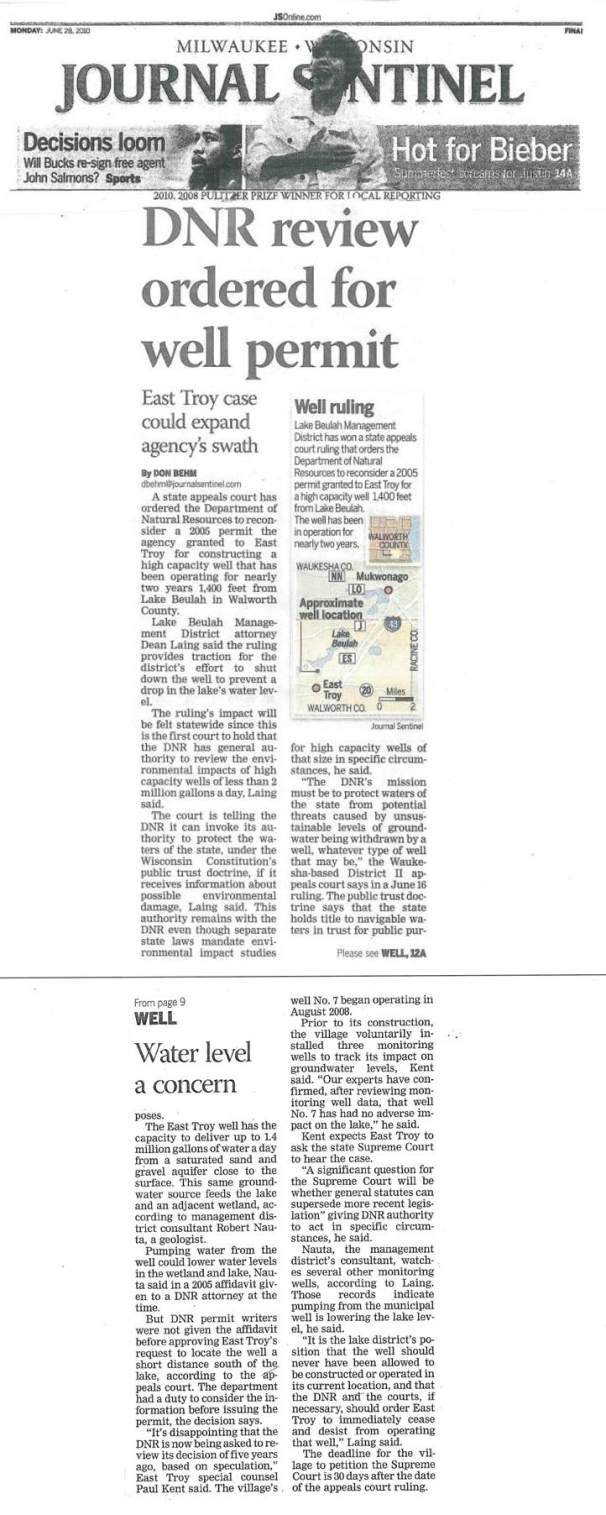
The below article, discussing a decision of the Wisconsin Court of Appeals in a case being handled by Attorney Dean Laing of our firm, was published in the June 28, 2010 edition of the Milwaukee Journal Sentinel. Our client, Lake Beulah Management District, was successful in the appeal.


Firm Obtains Favorable Decision from Wisconsin Court of Appeals

On June 16, 2010 the Wisconsin Court of Appeals issued a significant decision in a case of first impression being handled by our firm. The case has a long history. In 2005, the Wisconsin Department of Natural Resources (the “DNR”) issued a permit to the Village of East Troy (the “Village”) authorizing the Village to construct and operate a high capacity well approximately 1,400 feet from the shores of Lake Beulah, an 834-acre lake located in Walworth County, Wisconsin, with the capacity to withdraw 1,400,000 gallons of groundwater per day (“gpd”). The Village requested approval to construct and operate the well purportedly to eliminate current deficiencies and supplement for future growth.

The Lake Beulah Management District (the “District”), which consists mostly of residents owning frontage on the lake, objected to the issuance of the permit, contending that the proposed well would negatively impact the waters of the lake. The District contended that the DNR has a duty under the Public Trust Doctrine to determine whether a high capacity well, regardless of capacity, will negatively impact the waters of the State before issuing a permit to construct and operate such a well, and the DNR made no such determination in connection with the Village’s permit application. The Public Trust Doctrine is a long-standing legal doctrine which requires the State to steadfastly preserve the State’s waters for fishing, hunting, recreation and scenic beauty.

In 2006 the District filed a lawsuit in the circuit court challenging the issuance of the permit. In the lawsuit, the Village argued that the DNR has no authority to consider whether a high capacity well, with withdrawal capacity of less than 2 million gpd, will negatively impact the waters of the State in considering an application for such a well, because sections 281.34 and 281.35, Wis. Stats., only grant the DNR that authority for wells with withdrawal capacities of more than 2 million gpd. The DNR took a contrary position, arguing that while it has the authority to consider that issue for wells with withdrawal capacities of less than 2 million gpd, it had no duty to do so with respect to the Village’s permit application because no scientific evidence was presented to it indicating that the proposed well would negatively impact the waters of Lake Beulah. The District countered by arguing that not only did the DNR have the authority to consider whether the proposed well will negatively impact the waters of Lake Beulah, it had the duty to do so because the DNR had an affidavit of a licensed geologist, prior to issuing the permit, indicating that the well “would cause adverse environmental impacts to the wetland and navigable surface waters of Lake Beulah.”

The Wisconsin Court of Appeals agreed with the District. Initially, the court rejected the Village’s argument that the DNR has no authority to consider whether high capacity wells with withdrawal capacities of less than 2 million gpd will negatively impact the waters of the State before issuing a permit for construction and operation of such a well, holding that “[t]he permit process has to be, as a matter of common sense, more than a mechanical, rubber-stamp transaction,” and “[t]he DNR’s mission must be to protect waters of the state from potential threats caused by unsustainable levels of groundwater being withdrawn by a well, whatever type of well that may be.” (emphasis added)

The Court of Appeals further held that the geologist’s affidavit was “certainly” sufficient to warrant “further, independent investigation,” and remanded the case to the DNR to reconsider the Village’s permit application in light of that affidavit.

The Court of Appeals’ 25-page decision, issued by a unanimous 3-judge panel, will have far reaching impact on municipalities requesting high capacity well permits from the DNR, as the DNR must now consider the Public Trust Doctrine in connection with every application for such a permit, regardless of the well’s capacity, whenever there is information suggesting that the proposed well may negatively impact the waters of the State.

The District was represented by Dean P. Laing of our firm in this case. A copy of the Court of Appeals’ decision can be found here.

Firm Successfully Defends Class Action Lawsuit

Effective July 1, 2005, the Wisconsin law requires all mortgage brokers to use mortgage broker agreements and consumer disclosure statements in a form prescribed by the Wisconsin Department of Financial Institutions (“WDFI”) with their consumer clients. See Wis. Stat. § 224.79. The WDFI has stated that “no change to the wording of either form is acceptable or approved.” McGlone Mortgage Company, Inc. (“McGlone”), a Wisconsin licensed mortgage broker, did not begin using the WDFI prescribed forms until July 2008.

On February 20, 2009 John J. Avudria filed a class action lawsuit against McGlone on behalf of all persons who retained McGlone from July 2005 to July 2008, alleging that McGlone’s failure to use the WDFI prescribed forms during that period of time entitled them to damages of twice the amount of the loan origination fees charged by McGlone or their actual damages, whichever is greater, pursuant to section 224.80(2), Wis. Stats. John J. Avudria v. McGlone Mortgage Company, Inc., Milwaukee County (WI) Case No. 09-CV-2782.

Dean P. Laing of our firm represented McGlone in its defense of this class action lawsuit. On February 3, 2010 Mr. Laing filed a motion for summary judgment on behalf of McGlone, seeking dismissal of the lawsuit on various legal grounds.

On June 17, 2010 the trial court, the Honorable William W. Brash III, presiding, granted McGlone’s motion for summary judgment and dismissed the class action lawsuit, in its entirety, on the following legal grounds: (1) the statutes require a person to be “aggrieved” by a mortgage broker’s failure to use the State prescribed forms in order to state a claim upon which relief can be granted, meaning that the person must have suffered actual damages as a result thereof, which the plaintiff admitted in his deposition he did not, and (2) the statutes were not designed to allow claims against mortgage brokers which “inadvertently” fail to use the State prescribed forms, as the statutory scheme is aimed at egregious, not innocent, conduct.


Attorneys Laing and McBride Publish Annual Evidence Chapter

The 2010 edition of the Annual Survey of Wisconsin Law published by the State Bar of Wisconsin CLE Books has recently been released for circulation and this year’s work includes another contribution by Attorneys Dean P. Laing and Patrick G. McBride in the area of evidence. The Annual Survey reviews significant Wisconsin judicial and legislative developments from 2009 and is organized by individual chapters addressing recent developments in a specific area of law.

Attorney Laing has been the author or co-author of the evidence chapter of the Annual Survey for the past 22 years and Attorney McBride has been the co-author for the past nine years. This year’s chapter on evidence addresses issues regarding the admissibility of intercepted communications under the Wisconsin Electronic Surveillance Control Law and whether the one-party consent exception applies when both the intercepting person and the person consenting to the intercept are law-enforcement officers; and whether other acts evidence relating to a confidential informant’s observations on the day before the execution of a no-knock search warrant based on those observations was, nevertheless, admissible at trial to combat the defendant’s claim that he acted in self-defense when he shot a police officer who entered his home while executing the warrant.

The Wisconsin courts also addressed the admissibility of a computer-generated animation, which purported to illustrate the combined testimony of various witnesses regarding how the alleged crimes occurred, through the trial testimony of a non-expert witness who had no personal knowledge of the underlying facts and had not visited the crime scene. In a civil action, the court of appeals examined whether a defendant, who had invoked his Fifth Amendment privilege against self-incrimination and refused to testify regarding non-corporate liability exposure during the three-year discovery period before trial, should be permitted to withdraw the prior invocation and waive the privilege to testify during the last week of trial regarding issues that he had previously hidden from discovery.

The evidence chapter summarizes these decisions and others as they impact the development of the law of evidence in Wisconsin. A full copy of the evidence chapter appearing in the Annual Survey can be found here. A copy of the Annual Survey of Wisconsin Law can be obtained through the State Bar of Wisconsin CLE Books at www.wisbar.org


Attorney Dean Laing and Laura Now Contribute Article to the ABA Health Law Litigation Newsletter

The article, published in the American Bar Association, Section of Litigation, Committee on Health Law Litigation’s Winter 2010 Health Law Litigation Newsletter, discusses the common law development of a radiologist’s duty to directly communicate his or her findings to a treating physician, and how the American College of Radiology’s attempt to provide guidance to radiologists by establishing communication guidelines may not have had the effect that the ACR intended.

While the duty to directly communicate radiological findings has been firmly recognized by the courts for a number of years, courts have not been as consistent in articulating when that duty is triggered. The ACR originally set forth its recommendations to radiologists by creating its Standard for Communication-Diagnostic Radiology in September of 1991 which required radiologists to directly communicate their findings to treating physicians under certain circumstances. Since that time, this standard has undergone a number of revisions and is currently recognized as the ACR Practice Guideline for Communication of Diagnostic Imaging Findings. This Practice Guideline continues to provide guidance to radiologists regarding when direct communication with a treating physician may be necessary. More importantly, however, this Practice Guideline has increasingly been recognized and relied on by medical journal articles and the courts as evidence of a standard of care for the communication of radiological findings, despite the ACR’s explicit statement that its standards are not to be used to establish a legal standard of care.

Keeping this trend in mind, whether relying on established case law or the guidelines established by the ACR, radiologists should be especially diligent in communicating directly with a treating physician when the circumstances surrounding the radiologist’s findings mandate immediate communication.

A full copy of the A Radiologist’s Duty to Communicate with the Treating Physician can be found here.


Attorney Laing Secures Another Appellate Court Victory

On January 20, 2010, the Wisconsin Court of Appeals overturned a lower court ruling and held that, as Attorney Dean Laing had argued, an educational training reimbursement provision of an employment contract was divisible from unreasonable restrictive covenants in the contract and therefore enforceable. Attorney Laing’s argument enabled the appellate court to carefully avoid opining as to whether the Wisconsin Supreme Court has established a new divisibility test under Star Direct, Inc. v. Dal Pra, because the provisions were best viewed to be divisible under either that standard or the previously-established test set forth in Streiff v. American Family Mut. Ins. Co.

While the appellate court noted that the respective reimbursement and restrictive covenant provisions “share a common backdrop” as requirements of payment under the contract, in recognizing the enforceability of the reimbursement provision, the court specifically cited Attorney Laing’s argument that either provision could be stricken and the other could still be independently understood. As a result, that portion of the contract, which was not drafted by O’Neil Cannon, should and will remain in full force and effect.

A full copy of the opinion, which the appellate court recommended for publication in the official reports, can be found here.

See Article The Daily Reporter – Friday, January 22, 2010


Dean Laing Featured in Freeman Publications

Milwaukee, Wisconsin (September 14, 2007) – Dean Laing, a litigation attorney at the law firm of O’Neil Cannon was recently featured in articles appearing in the Waukesha Freeman and the Oconomowoc Enterprise.

The articles chronicled the story of Dean’s family and how growing up with two brothers with cerebral palsy impacted Dean’s career choice, spurring him towards an impressive career in both corporate and personal injury litigation. The article, entitled “A Brotherly Bond,” appeared in the Oconomowoc Enterprise on September 6, 2007 and in the Waukesha Freeman on September 12, 2007. The complete article can be viewed by clicking here.
Dean is the Practice Group Leader for the Firm’s litigation practice. He has been with the firm his entire legal career, since graduating cum laude from Marquette University Law School in 1983. Dean has been repeatedly recognized as one of Milwaukee’s and Wisconsin’s top trial attorneys, and exhibits a tremendous passion for the law and his clients. He has litigated some of the largest cases in Wisconsin, including representing Mitsubishi Heavy Industries America in the Miller Park dispute, and obtaining many million dollar settlements and verdicts for his clients.

O’Neil Cannon is a full-service legal practice focusing on business law, estate planning, and major complex litigation with offices in Milwaukee and Port Washington. The firm was established in 1973 and is now listed as one of the Milwaukee-area’s largest law firms.