Attorney Christa Wittenberg Wins 2019 Judge Terence T. Evans Humor and Creativity in Law Competition

Christa Wittenberg was recently announced the winner of the 2019 Judge Terence T. Evans Humor and Creativity in Law Competition, sponsored by the Eastern District of Wisconsin Bar Association. The award is given to one attorney each year whose original creative law-related writing piece is selected by the review committee. The competition honors the memory of the Honorable Terence T. Evans, former judge of the U.S. District Court, Eastern District of Wisconsin, and U.S. Court of Appeals for the Seventh Circuit, who was known for his wit and creativity throughout his life and his work. At the EDWBA Annual Meeting in April, Attorney Wittenberg happily accepted the award of a traveling trophy. Her winning article is below:

Boot Camp for Litigators: An Unconventional, Immersive CLE

By: Christa D. Wittenberg

Are you a litigator looking to improve your skills? Stuck in a career rut? Wishing you could practice the essential soft skills that make lawyers effective in and out of the courtroom? Try our 12-week intensive crash course: Parental Leave, also known as Boot Camp for Litigators. A brand new baby is required for this course; you will need to supply your own.

This innovative CLE emphasizes the skills that separate good lawyers from great lawyers, which are the same skills new babies force upon their parents: tenacity, flexibility, heightened awareness, creativity, and the ability to sift through crap. Our boot camp will give you the skills necessary to make you the litigator you’ve always dreamed of becoming. It’s guaranteed to give you the confidence to tell your opponents you can beat them while using just one arm. Literally.

The course focuses on the following areas:

Sleep deprivation resistance training: You will simulate the long days and sleepless nights of trial. Boasting 3-4 hours of interrupted sleep nightly, our boot camp will teach you to be impervious to the side effects of exhaustion in the highest stakes environment: your child’s life depends on it.

Thinking quickly on your feet: Improvising and adapting to challenging circumstances are crucial skills for litigators. Test your mental and emotional dexterity with countless tear-your-hair-out moments, like diaper blowouts, incessant screaming for no apparent reason, fending off well-meaning strangers trying to touch your child, politely nodding at your relatives’ terrible baby advice, and wrestling clothing onto your flailing infant. Like with any good improvisation class, instead of saying “no, please, no,” you’ll learn to say “yes, and . . . .” You’ll roll with the punches and make it work, because there’s really no alternative. After completing this boot camp, the next time you combat a challenging witness or argue your point to a frowning judge, your experienced brain will be hardwired to assess the situation and react deftly.

Reading a jury: Knowing whether a juror’s grimace is disbelief, sympathy, or merely the burrito he had for lunch is an important skill that allows you to adjust your trial strategy on the fly and win the case. After spending 12 weeks trying to guess the reasons for your baby’s many, many cries, you will find reading a fully-formed adult as easy as reading a book.

Public speaking: There’s simultaneously no tougher and no easier audience than a crying baby who could not care less what you are saying. If you can soothe an infant with a spontaneous, animated speech about the jungle animals swinging from his mobile, handling an opening statement will be a breeze.

Perseverance through tedium: We all know the exciting and glamorous parts of litigation—trials, depositions, oral arguments—don’t come along every day, and that it’s the preparation and background work that make up the bulk of our work as litigators. Sifting through thousands of documents for the needle in the haystack, poring over mountains of raw data to build a case, researching all variants of every possible legal theory to support your claims—such work cannot be done without the ability to persist in the face of extreme boredom. At our boot camp, you will face colossal tedium. For 12 weeks, around the clock, your life will follow a dismally predictable cycle: Feed. Change diaper. Soothe. Sleep. Repeat. After you complete this mind-numbing routine for that long, reading every Seventh Circuit decision on diversity jurisdiction since 1950 will sound like some welcome fun.

Dealing with demanding clients: You’ll rarely meet a client more irrational than an infant, and you don’t often have a client who screams at you more than your unsmiling newborn incapable of any other form of communication. Let your little one reinforce your talent for service with a smile.

Prioritizing: Parenting, like lawyering, is all about prioritizing. Imagine you have a brief due at midnight, a deposition tomorrow, and a demanding client calling every ten minutes. Now imagine you’re in the nursery, there’s spit-up on your shirt, poop everywhere else, and a hungry screaming infant lying on the changing table. In both scenarios, the key to success is efficiently tackling the problems in order of priority. Our boot camp will allow you to practice your triage skills in the relative comfort of your own home. For example, you might currently think showering every day or eating your meals while they’re hot are important, but you’ll soon learn otherwise. The same goes when you’re up against competing deadlines and demands—except you’ll probably still want to shower when handling your workplace challenges if you don’t want to offend your colleagues.

Gaining perspective: A healthy dose of perspective can help lawyers keep a clear head, even under great stress. Yes, we all want to do good work, win our cases, and strive for justice. But no single project or case will define you unless you let it. Caring for your child—for 12 weeks and beyond—will force you to slow down and see the forest instead of the trees.

Participants are admitted to Boot Camp for Litigators on a rolling basis. Sign up early, as there is typically a 9-month wait list for this life-changing course. This 12-week intensive course is pre-approved for 2,016 hours of CLE credits. Boot Camp for Litigators can be repeated as many times as you wish; the difficulty level increases each time.

Are you ready to see if our Boot Camp for Litigators can make you a better lawyer? Make the commitment today—if you dare!

OCHDL Is Pleased to Announce That Attorney Britany E. Morrison Has Joined the Firm

Attorney Britany E. Morrison, a graduate of Marquette University Law School, recently joined the Milwaukee law firm O’Neil Cannon Prior to joining the firm, Britany worked at a “Big Four” public accounting firm utilizing her certified public accounting license to help clients manage regulatory compliance risks and enhance returns. Britany is a member of the firm’s Business Law and Tax/Succession Practice Groups, and her practice will focus on tax planning.

O’Neil Cannon, founded in Milwaukee in 1973, is a full-service legal practice that primarily focuses on providing business law and civil litigation services to closely-held businesses and their owners. The firm represents corporations, institutions, and partnerships at all stages of the business life cycle, helping them start, grow and transition from one generation to the next. We also assist business owners with their personal legal needs including tax and estate planning, family law and litigation—including personal injury litigation.


Wisconsin Supreme Court Rules Unanimously for Firm’s Client in Property Tax Case

On March 14, 2019, the Wisconsin Supreme Court ruled that taxpayers need not operate their farms for a business purpose in order to have their farms classified as agricultural land for property tax purposes. The case is State ex rel. Peter Ogden Family Tr. of 2008 v. Bd. of Review, 2019 WI 23.

The firm’s clients, Peter Ogden and Terri Mahoney-Ogden, operate a small farm on approximately 12 acres of land near their home in the Town of Delafield, where they grow and harvest apples, hay, and Christmas trees. Despite previously assessing the property as “agricultural land” from 2012 through 2015, in 2016 the Town’s tax assessor changed the property’s classification to “residential”—even though the Ogdens had never stopped farming the land. The change in classification drastically increased the Ogdens’ property tax burden.

The Ogdens objected to the change in classification in a hearing before the Board of Review for the Town of Delafield. The tax assessor asserted that the Ogdens did not operate their farm sufficiently as a business. Even under this business standard, two members of the Board of Review still ruled for the Ogdens, though two did not. The tie went to the tax assessor and against the Ogdens. The Ogdens appealed.

The case ultimately made its way to the Wisconsin Supreme Court. There, the Court ruled, 7-0, that the tax assessor was incorrect. “No statute, administrative rule, or case law supports a business purpose requirement for the ‘agricultural land’ property tax classification,” the Court wrote.

Our Attorney, who represented the Ogdens in the case, explained to the Associated Press that the Court’s decision will help ensure uniformity in how agricultural land is taxed.

“Hopefully after today assessors won’t come to these off-hand conclusions about what’s not really in the law,” Our attorney said. “The whole purpose of the law is to help preserve Wisconsin’s farmland. This decision will help stop assessors from coming up with some other reason to change the classification. It’s good for small farmers around the state.”


Jim DeJong Awarded the 2019 Carroll University Distinguished Alumnus Award

Shareholder and past firm president Jim DeJong is the 2019 recipient of the P.E. MacAllister Distinguished Alumnus Award for his service to Carroll University. Named after P.E. MacAllister, alumnus from the class of 1940 and member of the Carroll Board of Trustees for over fifty years, the P.E. MacAllister Distinguished Alumnus Award for service to Carroll recognizes individuals for their extraordinary commitment and service to their alma mater.

“Jim has demonstrated his passion for and commitment to Carroll in numerous ways. He has been an active alumnus, assisting with alumni programs and other aspects of the campus community as the parent of two Carroll graduates. His leadership stood out as a board member – chair of the institutional advancement committee, co-chair of Carroll’s largest comprehensive campaign and chair of the presidential search committee. Jim also served with distinction as chair of the board and is a most deserving recipient of this award, named for P.E. MacAllister. Jim follows in his footsteps, as he has generously given of his time, talent and treasure.” – Dr. Cindy Gnadinger, President of Carroll University.

Carroll University’s Distinguished Alumni Award is the highest honor bestowed by the University. The award is provided to Carroll graduates based on their professional  achievements, contributions to society and support of the university.The recipients of this award are chosen based on their demonstrated quality of leadership, volunteerism, and professional excellence in their fields.

As an alumnus, Jim has served his alma mater in a variety of leadership capacities. He began his nine year tenure on Carroll’s Board of Trustees in 2008 and served as Board Chair for three years of his tenure. He was also a member of the President’s Advisory Council, Chair of the Board’s Institutional Advancement Committee, and Co-Chair of Campaign Carroll: The Common Thread.

Over the years, both Jim and his wife, Patty, have volunteered and appeared at multiple alumni and campus events, including regional gatherings throughout the U.S. Jim has served on several of his reunion committees throughout the years and delivered the commencement keynote address to Carroll’s Class of 2017.

Jim’s contributions to Carroll College are greatly valued, as expressed in an article published by the University on its website:

“Jim’s ongoing encouragement of alumni and friends to start and/or continue their engagement with Carroll is very beneficial and helps keep Carroll a very special place.”

Read the full honor here.


Wisconsin Supreme Court Rules in Favor of Firm’s Client

On January 29, 2019, the Wisconsin Supreme Court ruled in favor of our client, Park Bank, in a case of first impression in Wisconsin. In Koss Corp. v. Park Bank, 2019 WI 7, Koss Corp. sued Park Bank alleging that Park Bank acted in bad faith under the Uniform Fiduciaries Act (“UFA”) in failing to detect an embezzlement being conducted by one of Koss’s employees, Sue Sachdeva. Ms. Sachdeva embezzled $34 million from Koss Corp. over a 12-year period. The embezzlement was the largest embezzlement in Wisconsin history, and the ninth largest embezzlement in U.S. history.

Koss Corp. had some of its bank accounts at Park Bank, which Ms. Sachdeva used to embezzle $17 million from Koss Corp. by use of cashier’s checks she obtained from those accounts, which she used to pay her creditors for personal items such as jewelry, clothing and travel. Ms. Sachdeva was ultimately caught by an American Express employee, was criminally charged for her actions, and was sentenced to 11 years in prison.

After six years of litigation, the trial court granted Park Bank’s motion for summary judgment in 2016, ruling that the evidence did not support Koss Corp.’s claim that Park Bank acted in bad faith.

On December 12, 2017, the Wisconsin Court of Appeals affirmed that ruling.

On January 29, 2019, the Wisconsin Supreme Court affirmed the Wisconsin Court of Appeals’ decision in a 2-3-2 decision, with five Justices voting to affirm. The Court held that, to establish bad faith under the UFA, a bank must have acted dishonestly. The Court held that “[b]ad faith requires some evidence of bank dishonesty such as a bank willfully failing to further investigate compelling and obvious known facts that suggest fiduciary misconduct because of a deliberate desire to evade knowledge of fiduciary misconduct.” Decision at ¶ 55. In so ruling, the Court recognized several foundational principles that form the framework for analyzing a bank’s conduct when bad faith under the UFA is alleged:

First, bad faith is reviewed on a transaction by transaction basis, such that the facts known to each individual bank employee are not aggregated to form collective knowledge of the bank. Second, whether a bank acted in bad faith is determined at the time of the breach of fiduciary duty, not by looking back at transactions that occurred many months earlier.

             Third, bad faith is an intentional tort; negligence by a bank is insufficient to show bad faith. Fourth, considerations of bad faith require analyses of a bank’s actions to determine its subjective intent.

Id. at ¶¶ 52, 53.

In applying these foundational principles to the facts of the case, the Court held that “[w]hile discovery was extensive and conducted for years, no proof has been proffered from which a factfinder could find that any Park Bank transaction was not honestly done.” Id. at ¶ 71.

Our firm is proud to have represented Park Bank in this case, and pleased that all of the courts to have considered the matter — the trial court, the Wisconsin Court of Appeals, and the Wisconsin Supreme Court — all held that Park Bank has no liability to Koss Corp. in this matter.

Park Bank was represented by Dean Laing, Greg Lyons and Joe Newbold of our firm. Koss Corp. was represented by Michael Avenatti of California.


Attorney Kelly M. Spott Receives Peer Review Rating™ from Martindale-Hubbell®

O’Neil, Cannon, Hollman, DeJong and Laing S.C. has received notification from Martindale-Hubbell that Attorney Kelly M. Spott has received a Martindale-Hubbell® Peer Review RatingTM.

Kelly was given an “AV” rating from her peers–the highest rating–which means that she was deemed to have very high professional ethics and preeminent legal ability. Only lawyers with the highest ethical standards and professional ability receive a Martindale-Hubbell Peer Review Rating of AV.

Martindale-Hubbell conducts secure online Peer Review Ratings surveys of lawyers across multiple jurisdictions and geographic locations, in similar areas of practice as the lawyer being rated. Reviewers are instructed to assess their colleagues’ general ethical standards and legal ability in a specific area of practice.

The Martindale-Hubbell® Peer Review Ratings™ help buyers of legal services identify, evaluate and select the most appropriate lawyer for a specific task at hand. The confidentiality, objectivity and complete independence of the ratings process are what have made the program a unique and credible evaluation tool for members of the legal profession. The legal community values the accuracy of lawyer peer review ratings because they are determined by their peers – the people who are best suited to assess the legal ability and professional ethics of their colleague.


Attorneys Grant Killoran and Christa Wittenberg Speak at State Bar of Wisconsin’s Annual Constitutional Law Symposium

Grant Killoran and Christa Wittenberg of O’Neil, Cannon, Hollman, DeJong and Laing’s Litigation Practice Group recently presented at the State Bar of Wisconsin’s “Annual Constitutional Law Symposium 2018” in Pewaukee, Wisconsin.

Attorney Killoran was the Chair of the Symposium and authored an article and presented at the seminar on “The Current State of the Second Amendment.” Attorney Wittenberg authored an article and presented at the seminar on “Freedom from Litigation: Personal Jurisdiction and Sovereign Immunity.”

Attorneys Killoran and Wittenberg presented along with attorneys and professors from around Wisconsin and the country on various constitutional topics and issues.

Grant is a shareholder with the law firm and is the Chair of its Litigation Practice Group. He has significant and diverse trial experience representing clients in Wisconsin State and Federal Courts, and courts around the country, focusing on complex business, health care and employment law disputes. Grant also devotes a portion of his practice to arts and entertainment law, with an emphasis on the music industry.

Christa is a member of the Litigation Practice Group. She assists businesses and individuals with prosecuting and defending a variety of civil litigation matters, including complex contract disputes, trademark and copyright claims, inheritance disputes, class actions, personal injury cases, and fraud and conspiracy claims. As a former federal district court law clerk, Christa is intimately familiar with litigation and procedures in federal court. She has also litigated matters in state court, as well as resolved cases through mediation prior to litigation. Christa is well-versed in a wide range of legal issues, and especially enjoys litigating cases with disputes involving personal and subject-matter jurisdiction, testamentary capacity and undue influence, constitutional law, debt collection laws, contract formation and enforcement, and procedural and evidentiary rules.


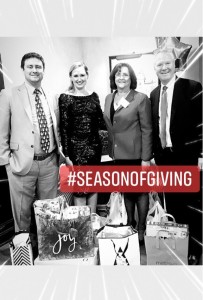
Season of Giving

In the spirit of the holiday season, the attorneys and staff at O’Neil Cannon recently collected items to be donated to The Women’s Center in Waukesha. The mission of the Women’s Center is to “provide safety, shelter, and support to empower all impacted by domestic abuse, sexual violence, child abuse, and trafficking.”

The services offered by The Women’s Center include emergency shelter for abused families, transitional living, counseling, child abuse prevention programming, legal advocacy and employment counseling. It also provides Hispanic outreach, community education programs, information and referral services, and a 24-hour hotline. If you are interested in donating or learning more about this amazing community organization, you can visit here to find more information.

Best wishes for the holiday season.


Dean Laing Speaks at Seminar

On November 29, 2018 Dean Laing spoke on the topic of “Procedural Issues in Litigation” at a seminar presented by the State Bar of Wisconsin on “Trending Topics in Business Litigation 2018.” The panel consisted of some of the top civil litigators in Wisconsin, and the seminar was very well attended. Mr. Laing spoke on various subjects, including the use of errata sheets following depositions, sequestration of persons from depositions, and use of general objections in discovery responses.

Mr. Laing has been a speaker at over 30 legal seminars, authored over 40 journal articles and book chapters, and been involved as counsel in over 75 published/reported decisions. Over the years, Mr. Laing has received numerous recognitions for his legal work, including being selected four times as one of the “Top 10 Lawyers” in Wisconsin by Super Lawyers; three times as “Lawyer of the Year in Wisconsin” by The Best Lawyers in America; and one time as a “Leader in the Law” by the Wisconsin Law Journal.

Mr. Laing can be reached at 414-276-5000 or dean.laing@wilaw.com.


OCHDL Earns Recertification in Meritas

O’Neil, Cannon, Hollman, DeJong and Laing S.C. has been awarded recertification in Meritas, a global alliance of independent business law firms. O’Neil, Cannon, Hollman, DeJong and Laing S.C. joined Meritas in 2012 and, as a condition of its membership, is required to successfully complete recertification every three years.

Meritas is the only law firm alliance with an established and comprehensive means of monitoring the quality of its member firms—a process that saves clients time validating law firm credentials and experience. Meritas membership is selective and by invitation only. Firms are regularly assessed and recertified for the breadth of their practice expertise and client satisfaction. The organization’s extensive due diligence process ensures that only firms meeting the tenets of Meritas’ unique Quality Assurance Program are allowed to maintain membership. Firm performance and quality feedback are reflected in a Satisfaction Index score, which is made available online.

“We greatly appreciate the many benefits of being a  member of the Meritas network and look forward to continuing our relationship with Meritas for years to come,” said Pete Faust, a member of the Board of Directors at O’Neil, Cannon, Hollman, DeJong and Laing S.C. “Meritas’ Quality Assurance Program is not just valuable for our clients seeking legal expertise around the world; it also provides us with a framework to consistently monitor and enhance the quality of our services.”

The recertification process includes exacting self-assessment, peer review by other law firms and client feedback. It examines such factors as timeliness and quality of a firm’s client service, professional conduct and adherence to Meritas policies including acknowledgment of Meritas firm or client correspondence within 24 hours.

“Businesses trust the Meritas alliance of law firms for top-tier quality, convenience, consistency and value,” said Tanna Moore, president and CEO of Meritas. “O’Neil, Cannon, Hollman, DeJong and Laing S.C. has demonstrated its commitment to world-class client service, and therefore has successfully earned its recertification in Meritas.”